Stapled, Copied, and Counted: Why Zines Are Becoming the Archival Record America Didn't Know It Was Making
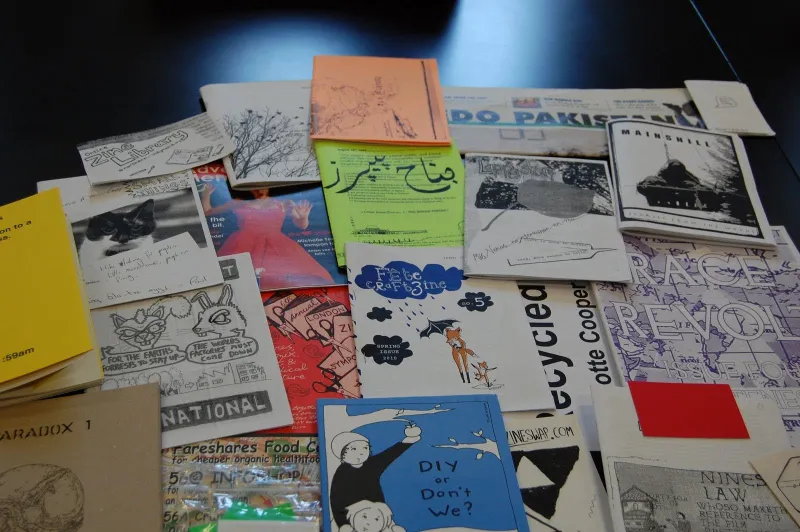
Photo: zine collection colorful handmade publications spread on table, via i.pinimg.com
The Publication No One Was Supposed to Keep
There is a particular kind of object that archivists have learned to love despite themselves: the zine. Photocopied at a corner print shop, stapled at the kitchen table, distributed at record stores and community centers and protest marches, zines were never designed to last. They were made to circulate, to agitate, to reach a specific person at a specific moment. Permanence was beside the point.
And yet, inside those hand-trimmed pages, something remarkable was being preserved. The concerns of a queer teenager in rural Ohio in 1994. The mutual aid networks that sustained a Latinx neighborhood in Chicago before any nonprofit came to document them. The aesthetic arguments of a noise music collective in Portland that never signed to a label and never sought broader recognition. These are the kinds of stories that mainstream archives — those housed in universities, municipal buildings, and national institutions — have historically struggled to collect, whether from indifference, inaccessibility, or simple ignorance of where to look.
Today, a growing number of librarians, independent archivists, and zine makers themselves are working to ensure that these ephemeral objects outlast the circumstances of their creation.
What Zines Actually Are — and Why That Matters
The word "zine" (a shortening of "fanzine," itself derived from "fan magazine") encompasses an enormous range of publications. At their most basic, zines are self-produced, small-circulation print works made outside the structures of commercial publishing. They have existed in recognizable form since at least the science fiction fan communities of the 1930s, and they proliferated dramatically through the punk and riot grrrl movements of the 1970s, 1980s, and 1990s.
What distinguishes a zine from a self-published book or an independent magazine is largely a matter of intention and infrastructure. Zines are typically produced with minimal resources — photocopiers, risograph printers, hand-drawn illustrations, cut-and-paste typography — and distributed through informal networks. A print run of fifty copies is not unusual. A print run of five hundred is considered large.
This modesty of scale is precisely what makes zines so valuable as historical documents. Because they are produced cheaply and quickly, they respond to the present moment with an immediacy that more formal publications cannot match. A zine produced during the early weeks of the COVID-19 pandemic, or in the days following a local police shooting, or in response to the closure of a beloved community space, captures something that a newspaper article or a scholarly monograph will miss: the texture of lived experience, unmediated by editorial distance or institutional caution.
The Preservation Problem
The challenge, of course, is that zines were built to be fragile. Newsprint yellows. Staples rust. Photocopier toner flakes. And because many zine makers never considered their work archival material, copies were rarely stored with any care. They ended up in cardboard boxes, in the back rooms of closed record stores, in the attics of people who have since moved three times.
"We lose zines the same way we lose diaries," says one librarian who manages a zine collection at a public library in the Pacific Northwest. "People don't throw them away because they seem unimportant. They disappear because no one thought to treat them as important."
The problem is compounded by the demographics of zine production. Zines have historically been made by people — young people, queer people, people of color, people with disabilities, people living in rural or economically marginalized communities — whose cultural output has been systematically undervalued by collecting institutions. The result is a gap in the archival record that mirrors broader inequities in whose stories get preserved.
Several institutions are working to close that gap. The Barnard Zine Library in New York, the Denver Zine Library, and the Queer Zine Archive Project, among others, have developed specialized collections that treat zines with the same seriousness as any other primary source. Some university libraries have begun actively soliciting zine donations. The Interference Archive in Brooklyn has built an entire repository around the printed ephemera of social movements.
The Creators as Archivists
Perhaps the most significant development in zine preservation is the growing awareness among zine makers themselves that their work constitutes a historical record worth protecting. A new generation of independent publishers is approaching the act of creation with one eye already on posterity.
In cities like Philadelphia, Minneapolis, and Austin, zine fests — annual gatherings where makers sell and trade their work — have begun incorporating discussions about archiving, digitization, and long-term storage. Makers are exchanging knowledge about acid-free paper, proper storage conditions, and how to approach libraries about donation.
Some have gone further. Collectives in several cities have established informal "distros" — distribution networks that also function as de facto archives, maintaining organized collections of everything they carry and making them available for research. Others have begun digitizing their own back catalogs, uploading scanned issues to platforms like the Internet Archive, where they are freely accessible to anyone with an internet connection.
This grassroots approach to self-preservation reflects something central to zine culture: a foundational skepticism of institutions, paired with an equally strong commitment to community. Zine makers have always understood that if their stories were going to be told, they would have to tell them themselves. It turns out the same principle applies to keeping those stories safe.
What Is Being Saved — and What Remains at Risk
The breadth of what zines document is difficult to overstate. Collections held by libraries and archives across the country contain zines devoted to disability justice organizing, to the experiences of Indigenous youth in urban environments, to the underground food scenes of mid-sized American cities, to the spiritual practices of communities that have no formal religious institutions, to the grief of parents who have lost children to gun violence.
None of these subjects would be likely to generate a book deal. Most would not merit more than passing mention in a regional newspaper. But they are part of the lived reality of American communities, and they deserve a place in the historical record.
What remains most at risk is the material that exists in only a single copy, held by a single person who may not realize its significance. A zine produced in 1987 by a gay youth group in rural Alabama. A bilingual publication made by Vietnamese refugees in a resettlement community in the 1980s. A feminist literary journal produced by women incarcerated in a state correctional facility. These objects exist somewhere, in someone's possession. Whether they survive the next decade depends on whether anyone thinks to look for them.
A Library's Responsibility to the Unofficial Record
The mission of any library or archive worth its name is not simply to house what has already been deemed important, but to anticipate what future researchers will need. The zine collections being assembled today — painstakingly, with limited funding, often by volunteers working in their spare time — represent exactly that kind of forward-looking stewardship.
They are building the archives that formal institutions have not yet thought to create: repositories of the unofficial, the handmade, the deliberately marginal. In doing so, they are ensuring that the full complexity of American life in the late twentieth and early twenty-first centuries will be recoverable by those who come after us.
The staple-bound, photocopied, hand-delivered zine was never meant to last. That is, perhaps, exactly why it must.